WASigns & road rules3 min readUpdated
Washington school buses: when each direction must stop
Understand Washington’s two-lane, multilane and divided-road school-bus rules, then work through common stopping scenarios.
By the US DMV editorial team · Passenger-car permit study
Identify the bus signal, your direction and the road
When a school bus stops on the roadway to load or unload children with its required stopping signals operating, Washington’s starting rule is to stop before reaching the bus. RCW 46.61.370 provides specific exceptions for drivers meeting the bus from the opposite direction. A wider road does not create an exception for traffic traveling behind the bus.
Use this comparison when the bus is stopped with red lights flashing:
| Road layout | Traveling in the bus’s direction | Meeting the bus in the opposite direction |
|---|---|---|
| Two-lane road, one lane each way | Stop | Stop |
| Highway with three or more marked traffic lanes | Stop | Opposite-direction exception applies |
| Highway divided into separate roadways | Stop on the bus’s roadway | Opposite-roadway exception applies |
The two exceptions are separate: three or more marked lanes do not also need a physical median to qualify. Stay attentive to children even where you are not required to stop for the bus.
Compare four roadway layouts
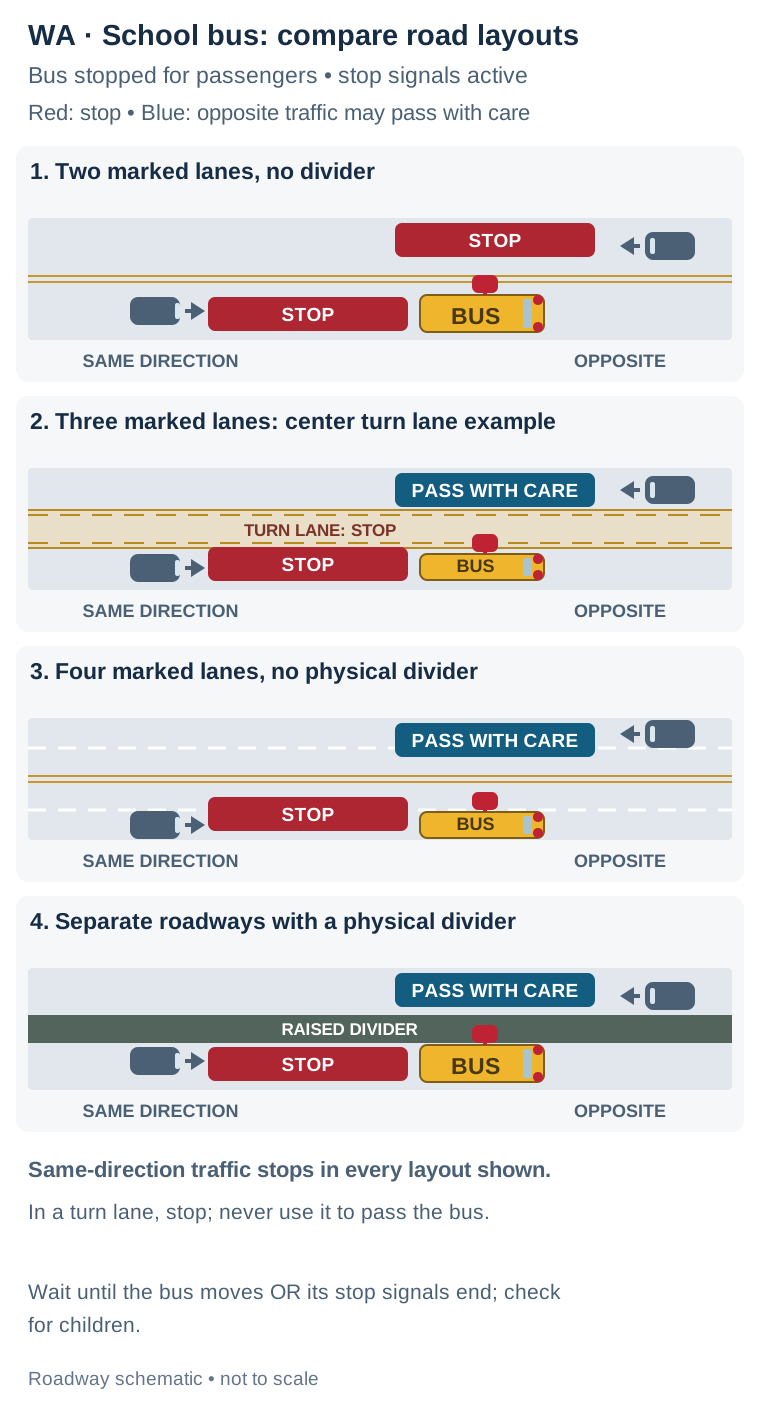
The marked-lane and separate-roadway exceptions apply independently to opposite traffic. The center turn lane is marked STOP: never use it to pass the bus. The restart conditions appear below the layouts and in the article. Select the image to enlarge it. Original diagram based on current official rules.
Work through three common situations
You are behind a bus on a four-lane road. The bus activates its red stopping lights. Stop before reaching it even if a neighboring lane appears empty. Changing lanes does not turn you into opposite-direction traffic.
You meet a bus on an ordinary two-lane neighborhood street. There is one lane each way and no separate roadway. Stop. The fact that you are across the centerline does not create the multilane or divided-highway exception.
You approach in a turn lane. Do not use it to pass a stopped school bus. The Washington Driver Guide’s school-bus section specifically warns against passing in the center turn lane and says drivers in turn lanes must stop.
Approach early and restart carefully
Yellow bus lights mean caution: slow down and prepare for the bus to stop. Leave yourself room for a controlled stop instead of accelerating to get past before the red lights start. Check mirrors as you slow, while keeping attention on the bus and roadside.
The statute says to remain stopped until the bus resumes motion or the stopping signals are no longer activated. Follow the guide’s practical restart check: red lights have stopped flashing, the stop sign has retracted and the crossing arm has returned. Check for children before moving, including someone who may approach from behind a parked car.
A bus stopped completely off the roadway may use hazard lamps under a separate provision when children do not need to cross the road. Distinguish ordinary hazard lights from the red loading/unloading signals; remain cautious around every bus stop. If you cannot identify the road layout or signals in time, slow early and leave space to respond safely.
WA Driver
Use WA Driver for practice in English, Spanish or Chinese, then review your mistakes. App questions are independent study material.