WASigns & road rules4 min readUpdated
Washington emergency vehicles: pull over or move over safely
Learn the different actions for an approaching emergency vehicle and a roadside response scene, including Washington’s speed rules.
By the US DMV editorial team · Passenger-car permit study
Choose the action for the situation
An ambulance coming up behind you needs a clear route. A tow operator working beside a stopped car needs space around the scene. Both require an early response, but the maneuvers differ. Look well ahead, check mirrors and identify whether the vehicle is approaching or is working beside the road.
Pull over and stop, or move away and slow?
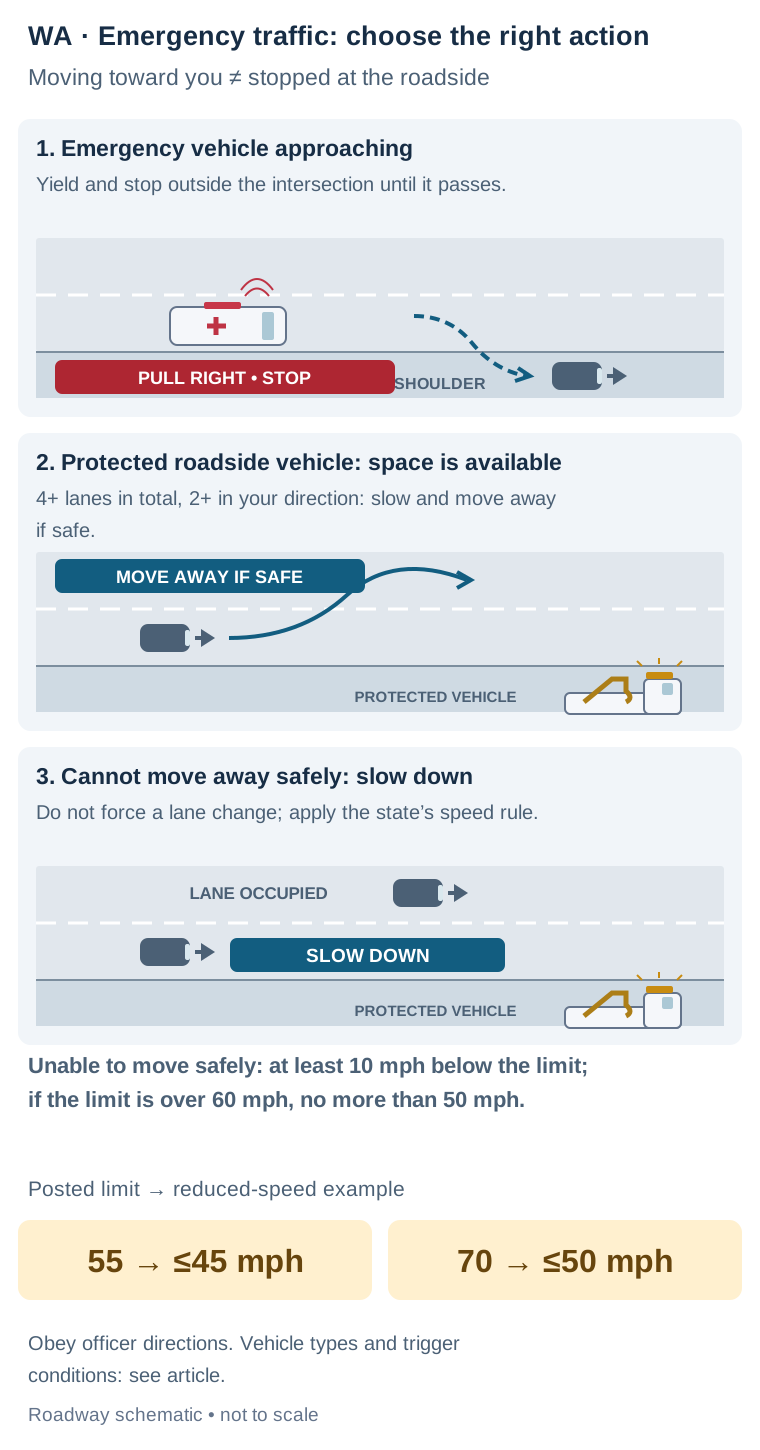
The approaching ambulance uses lawful lights and siren; the stopped tow truck uses the required warning lights. Only your direction is drawn. The last two panels represent a highway with at least four total lanes and two in your direction; the 200-foot zones before and after, other road layouts and work conditions are explained below. Select the image to enlarge it. Original diagram based on the roadside rule and approaching-emergency rule.
When an emergency vehicle approaches
Under RCW 46.61.210, yield to an approaching authorized emergency vehicle using the required audible and visual signals. The rule also covers a police vehicle lawfully using an audible signal alone and qualifying time-urgent organ transport vehicles using the required signals.
Move parallel to and as close as possible to the right edge or curb, clear of an intersection, and stop. Remain there until the vehicle passes unless a police officer directs otherwise. If already in an intersection, clear it safely before stopping. Check for another responding vehicle before you signal and rejoin traffic.
For example, hearing a siren while waiting at an intersection does not make a sudden turn across another lane safe. Locate the vehicle, keep its route open and make a controlled movement when safe. Follow an officer’s direction at a managed scene.
When you approach a roadside emergency or work zone
RCW 46.61.212 defines this zone as the adjacent lanes 200 feet before and after the specified vehicle. Covered vehicles include properly signaling emergency and police vehicles, tow trucks, qualifying roadside-assistance vehicles, and stationary or slow-moving construction, maintenance, solid-waste and utility vehicles using the specified warning lights.
Approach cautiously and reduce speed. On a highway with at least four lanes, including at least two in your direction, move away from the occupied lane or shoulder when the traffic and safety conditions allow. On a highway with fewer than four lanes, pass to the left at a safe distance only when lawful and safe, yielding to traffic traveling in its proper direction.
If changing lanes or moving away would be unsafe, continue cautiously and slow to at least 10 mph below the posted limit; where the posted limit exceeds 60 mph, the rule requires no more than 50 mph. These are ceilings for that situation, not targets you must reach in poor conditions.
Examples when moving away is unsafe:
| Posted limit | Maximum under the fallback speed rule |
|---|---|
| 35 mph | 25 mph |
| 55 mph | 45 mph |
| 70 mph | 50 mph |
A vehicle occupying the lane beside you may prevent a safe merge. Reduce early, keep space and pass cautiously; do not force another driver to brake sharply so you can move over. Keep the reduced speed through the scene rather than accelerating beside a worker.
A practical scan-and-response routine
- Identify flashing lights early and ease off the accelerator.
- Check mirrors, neighboring lanes and approaching traffic before deciding where to move.
- Signal, create space and move only when lawful and safe.
- Keep attention on people, equipment and traffic until you are clear of the zone.
For ongoing study, use the official Washington Driver Guide. The free Work Zone and First Responder Course is available now. As of October 30, 2026, its mandatory requirement is upcoming: it applies to first WA licenses obtained on or after November 1, 2026, when the applicant is under 25 on the licensing date.
WA Driver
Use WA Driver for practice in English, Spanish or Chinese, then review your mistakes. App questions are independent study material.