VASigns & road rules3 min readUpdated
Virginia school bus rules: when both directions must stop
Recognize when Virginia school bus stops apply to your direction, what counts as a physical separation and when it is lawful to move again.
By the US DMV editorial team · Passenger-car permit study
When a Virginia school bus stops to load or unload passengers, stop when approaching from either direction, unless a specific exception applies. A painted centerline or center turn lane does not create the physical separation needed for the opposite-roadway exception.
Compare the road layouts
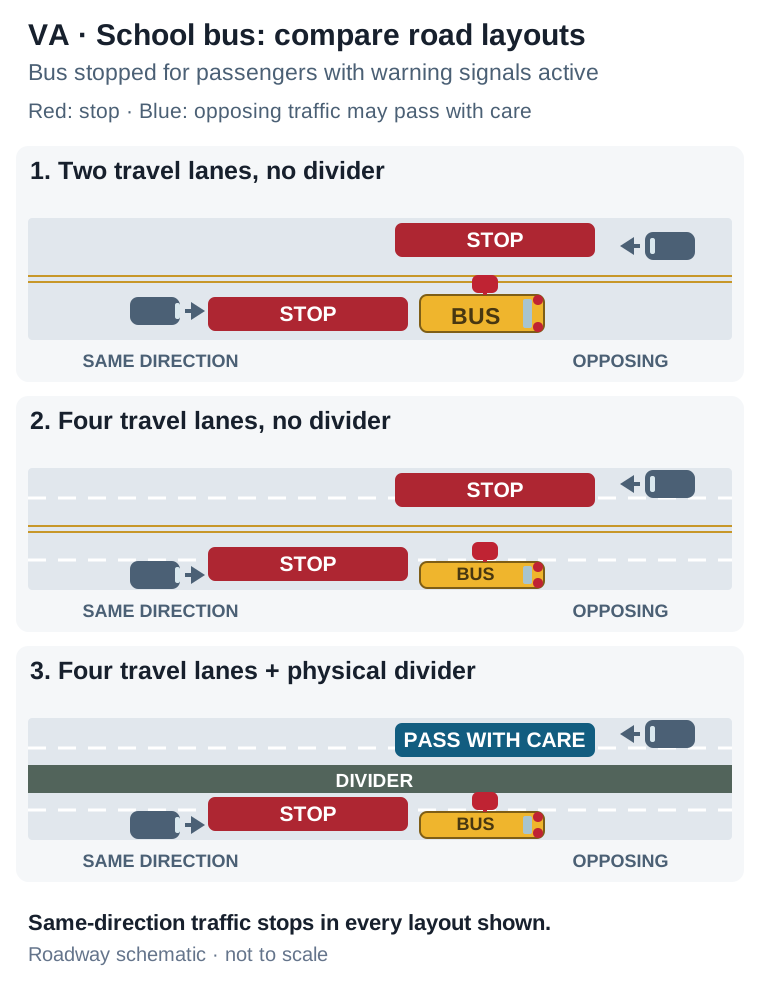
Open the diagram to enlarge it. Original roadway schematic based on the linked official rule. Read the full conditions below. §46.2-859.
Identify the bus and the road before deciding
The DMV school bus safety page says to stop for a stopped school bus showing flashing red lights and an extended stop sign. It also expressly says to stop when passengers are loading or unloading even if the lights and stop sign are not activated. Do not use a missing signal as permission to pass a bus that is visibly serving passengers.
The legal stopping rule in Virginia Code § 46.2-859 covers highways, private roads and school driveways. It includes buses serving children and the other passenger groups specified in the statute. A school setting does not make passing automatically lawful.
| Situation | Your action |
|---|---|
| You approach behind the bus on the same roadway | Stop; a median separating opposing traffic does not exempt traffic behind the bus |
| The bus faces you across a painted line, painted median or center turn lane | Stop; paint is not a physical barrier or unpaved area |
| The bus is on another roadway, access road or driveway separated from yours by a physical barrier or unpaved area | The statutory separated-roadway exception applies; continue cautiously and watch for people |
| A barrier or unpaved separator has openings for intersections or turning vehicles | Those openings do not by themselves eliminate the exception when the bus is on the separated roadway described in the statute |
| The bus is loading or unloading immediately beside a school and a police officer or authorized uniformed school crossing guard directs you past | Follow that authorized direction; the school location alone is insufficient |
If you cannot tell whether the roadway is physically separated, slow early and stop rather than deciding from the number of lanes. A broad paved road with several lanes can still require both directions to stop.
Remain stopped until both conditions are met
Virginia’s rule is to remain stopped until all the passengers are clear of the highway, private road or school driveway and the bus has moved. Do not restart just because the stop arm folds, another driver starts moving or you no longer see the first child. Keep checking both sides and the front of the bus.
The manual’s safe-driving section reinforces the stop requirement and the separated-roadway exception. Keep a useful stopping margin behind the bus and leave space for an unexpected child to appear. Leave a clear view of the bus and avoid crowding the space where passengers may walk.
Use a repeatable approach
- As you approach a bus stop or a slowing bus, ease off the accelerator and check behind you.
- Identify whether you share the bus’s roadway or are on a genuinely separated roadway.
- Stop when required, even if the loading/unloading bus has no active lights or stop arm.
- Keep the vehicle stopped while watching passengers, then proceed only when the legal release conditions are met.
Passing a stopped school bus in violation of § 46.2-859 is reckless driving. Focus on the road layout and the people, not on whether the driver ahead takes a chance.
Practice explaining this rule with the official knowledge-test materials. For a different roadside situation, see Virginia’s Move Over and approaching-emergency-vehicle rules.
Put what you learned into practice
VA Driver is coming soon. Use the state study resources and official handbook in the meantime.
State study resources