TXSigns & road rules4 min readUpdated
Texas Move Over or Slow Down: vehicles, speeds and safe decisions
Know which roadside vehicles are protected, how far to slow when you cannot change lanes, and what to do when an emergency vehicle approaches.
By the US DMV editorial team · Passenger-car permit study
When you approach a protected roadside vehicle in Texas, create space for the people working there. On a highway with at least two lanes traveling in your direction, leave the lane closest to the vehicle or slow to the legal reduced speed. If a lane change is unsafe or unavailable, begin slowing early and pass carefully. A police officer’s directions take priority.
The current rule is Texas Transportation Code §545.157. TxDOT’s Move Over or Slow Down guide explains how to apply it on the road.
Separate the two situations and the choices
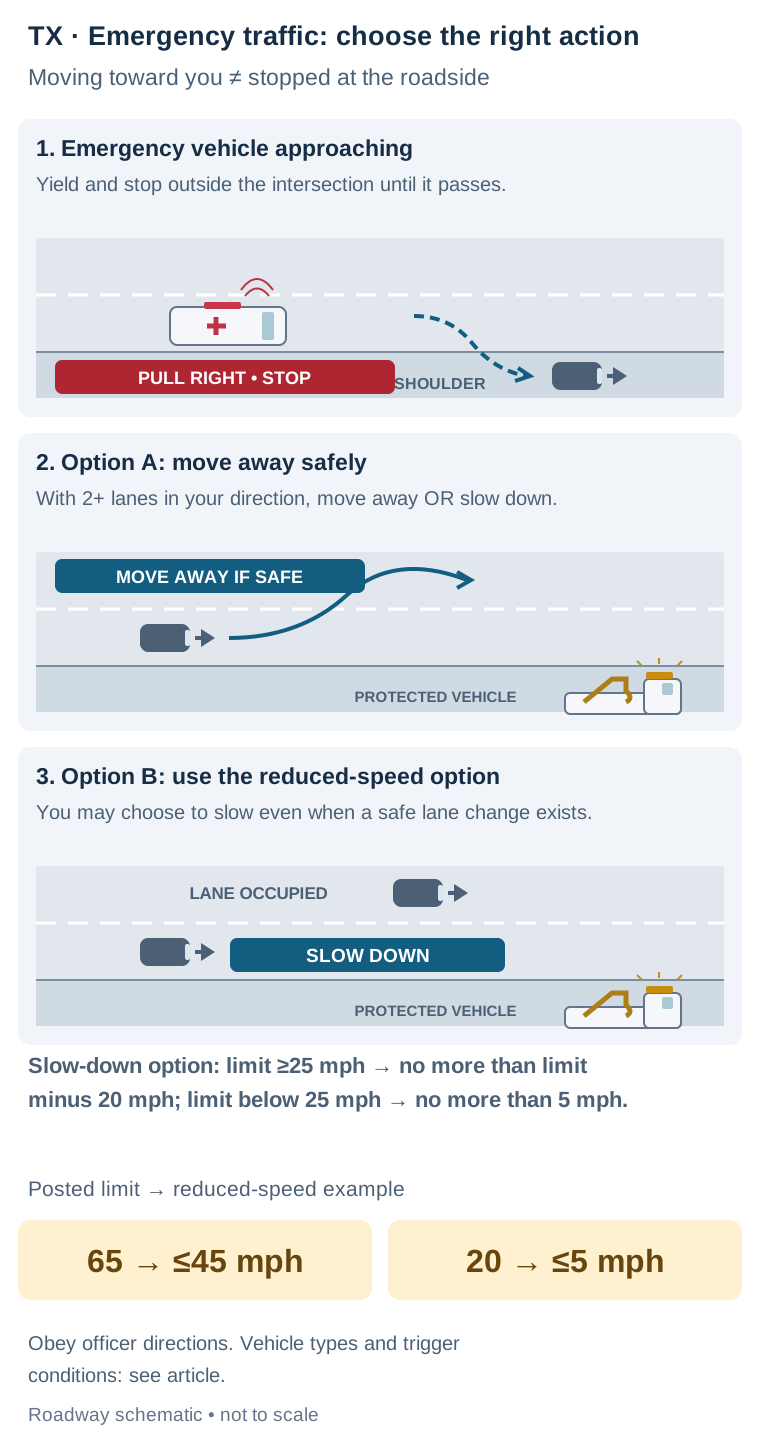
The roadside example is a stationary tow truck with its required warning lights, showing only your direction. Safely moving away and using the legal slow-down option are alternatives; never force an unsafe merge. Covered vehicle categories, work and signal conditions, and approaching-emergency requirements are detailed below. Select the image to enlarge it. Original diagram based on the roadside rule and approaching-emergency rule.
Which vehicles does the law cover?
The statutory categories have specific operating and lighting conditions:
- Stationary authorized emergency vehicles using the required visual signals, and stationary tow trucks using authorized warning equipment.
- TxDOT vehicles and qualifying contracted highway construction or maintenance vehicles using the required signals, when they are not separated from the roadway by a traffic-control channelizing device.
- Utility service vehicles using the required signals.
- Stationary vehicles used exclusively for municipal solid waste or recyclables, while collecting or transporting those materials from a location adjacent to the highway.
- Vehicles operated by or under contract with a toll project entity, using the required signals.
- Animal-control vehicles removing animals or carcasses from the road, and vehicles of people authorized to remove animal carcasses, using the required signals.
- Local-authority employees’ vehicles used to issue parking citations, using the required signals.
This list reaches beyond police cars and ambulances. Pay attention to roadside work and the applicable warning signals. Even when a disabled private car does not fall within one of these categories, leave space and use caution around anyone near traffic.
If you slow down, calculate the actual maximum
The speed option is a speed no greater than the posted limit minus 20 mph when that limit is 25 mph or higher. Where the posted limit is below 25 mph, the maximum is 5 mph.
| Posted limit | Maximum under the slow-down option |
|---|---|
| 75 mph | 55 mph |
| 65 mph | 45 mph |
| 35 mph | 15 mph |
| 25 mph | 5 mph |
| 20 mph | 5 mph |
These are maximums for that option; conditions may require a lower safe speed. Simply taking your foot off the accelerator does not establish that you reached the required speed. Check traffic behind you, reduce speed smoothly and keep watching the work area.
Three practical decisions
A tow truck is on the shoulder of a 65-mph road, and the next lane is occupied. Do not force a sudden merge. Use the slow-down option: 45 mph or less while passing, with a lower speed if conditions require it.
You see a qualifying utility vehicle with signals on a road with one lane each way. There is no other lane traveling your direction to vacate. Slow to the statutory maximum and pass with care; do not treat the opposing lane as an automatic escape lane.
You see an ambulance approaching with lights and siren. Apply the approaching-emergency-vehicle rule in §545.156: yield, move parallel and as close as possible to the right edge or curb clear of the intersection, and stop until it passes, unless a police officer directs otherwise. That is a different situation from passing a stopped roadside vehicle.
For practice, identify the vehicle and its activity first, then count same-direction lanes, check for a safe space and calculate the reduced speed before reaching it.
Reviewed October 30, 2026. TX Driver is available on Google Play with English, Spanish and Chinese rule practice.
TX Driver
Use TX Driver for practice in English, Spanish or Chinese, then review your mistakes. App questions are independent study material.