FLSigns & road rules3 min readUpdated
Florida school-bus stopping rules: which drivers must stop?
Use travel direction and the type of median to decide when Florida requires a full stop for a school bus.
By the US DMV editorial team · Passenger-car permit study
When a stopped school bus displays its stop signal, Florida generally requires approaching drivers to stop completely. A painted center area does not create the divided-highway exception. The two useful questions are: Am I traveling in the bus’s direction, and what actually separates opposing traffic?
Compare the divider and its width
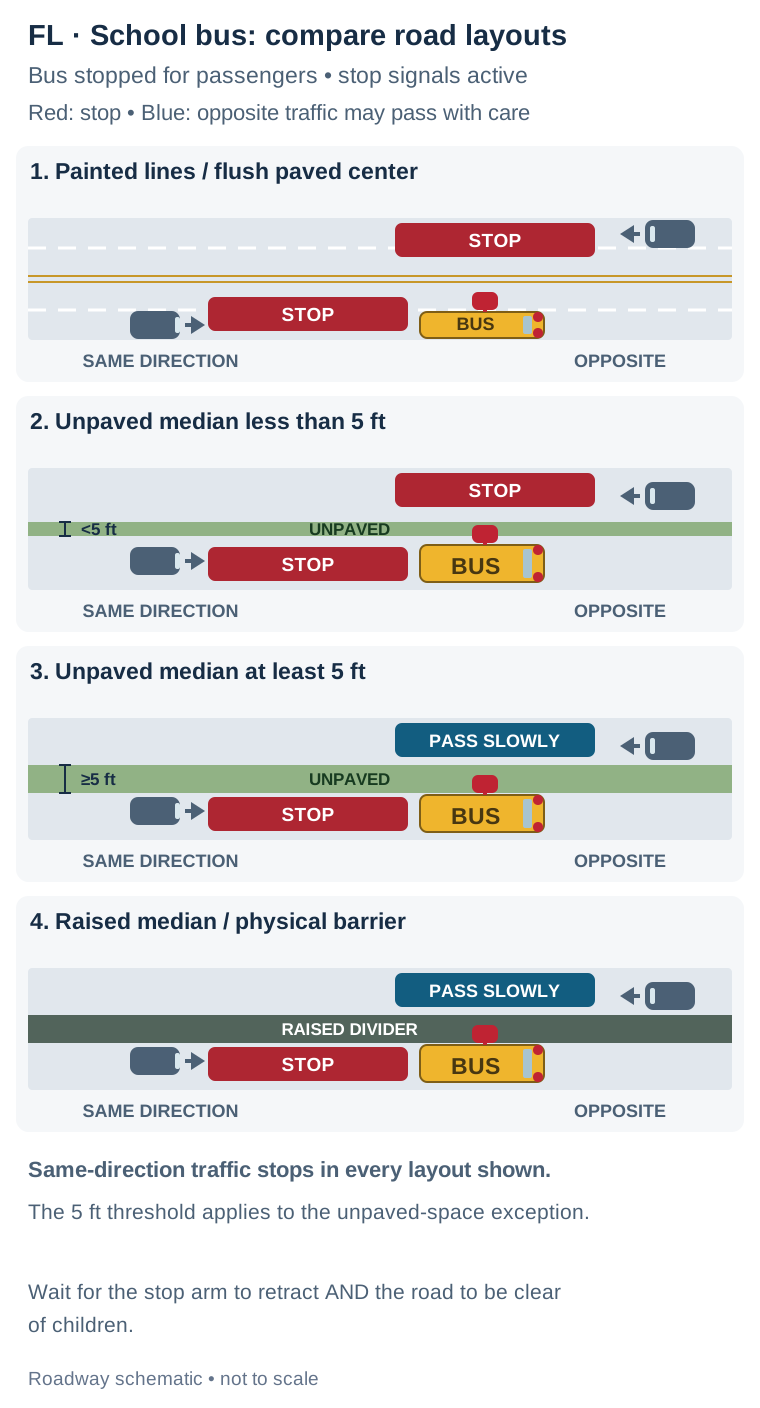
The 5-foot threshold applies to unpaved space, not as an extra condition for a raised median or physical barrier. Drivers required to stop wait until the stop arm is withdrawn and the road is clear of children. Select the image to enlarge it. Original diagram based on current official rules.
Read the roadway before deciding
Florida Statutes section 316.172 makes the exception specific to drivers traveling in the opposite direction on a highway divided by an unpaved space at least five feet wide, a raised median or a physical barrier. It does not exempt traffic following the bus.
| Road layout when the bus displays its stop signal | Traffic behind the bus | Opposing traffic |
|---|---|---|
| Two-way road without a qualifying divider | Stop | Stop |
| Multiple lanes with painted markings or a flush paved center area | Stop | Stop |
| Divided highway with an unpaved median at least five feet wide, a raised median or physical barrier | Stop | The divided-highway exception applies; slow down and watch for children |
The five-foot threshold applies to the unpaved space. Do not treat every paved median as qualifying: FLHSMV’s school-bus safety guide distinguishes ordinary paved center areas from raised barriers. Painted lines alone do not separate traffic in the way the exception requires.
Work through three everyday situations
A broad road with a center turn lane: A bus stops across from you on the other side of the painted turn lane. The road may feel divided, but there is no qualifying physical or unpaved separation. Stop even if there are several lanes between your car and the bus.
A grassy divided road: The bus stops across a grassy median at least five feet wide. If you are traveling in the opposite direction, the exception applies. Continue with caution and watch for children. A driver behind the bus on its carriageway must still stop.
A bus in the right lane beside you: You approach in the left lane, traveling the same direction. The exception for opposing traffic does not apply. Stop; do not use the extra lane to pass the bus.
Wait for both the signal and a clear roadway
FLHSMV instructs drivers who must stop to remain stopped until the bus stop arm is withdrawn and the roadway is clear of children. If the arm retracts while a child is still crossing, wait. Check around the front of the bus and near its sides before moving; the bus can hide a pedestrian from your initial view.
Read a yellow school-bus warning as a reason to slow and prepare, rather than accelerate around the bus. When the red lights and stop arm are displayed, apply the stopping rule. Follow a crossing guard’s directions and keep attention on children even when a divided-road exception applies.
For FL Driver practice, change one detail at a time: same direction versus opposite direction, painted center area versus raised divider, and five feet of unpaved median versus less. Explain why that detail changes the decision. These are learning scenarios, not reproduced official exam questions.
FL Driver
Use FL Driver for practice in English, Spanish or Chinese, then review your mistakes. App questions are independent study material.