FLSigns & road rules3 min readUpdated
Florida Move Over law: stopped vehicles and approaching emergencies
Distinguish yielding to a moving emergency vehicle from changing lanes or slowing for protected vehicles stopped beside the road.
By the US DMV editorial team · Passenger-car permit study
An ambulance approaching with emergency signals and a disabled car on the shoulder require different responses. Florida’s section 316.126 covers both: yield and stop for an approaching emergency vehicle; move out of the nearest lane or slow as required for a protected roadside vehicle.
Is the emergency approaching or stopped roadside?
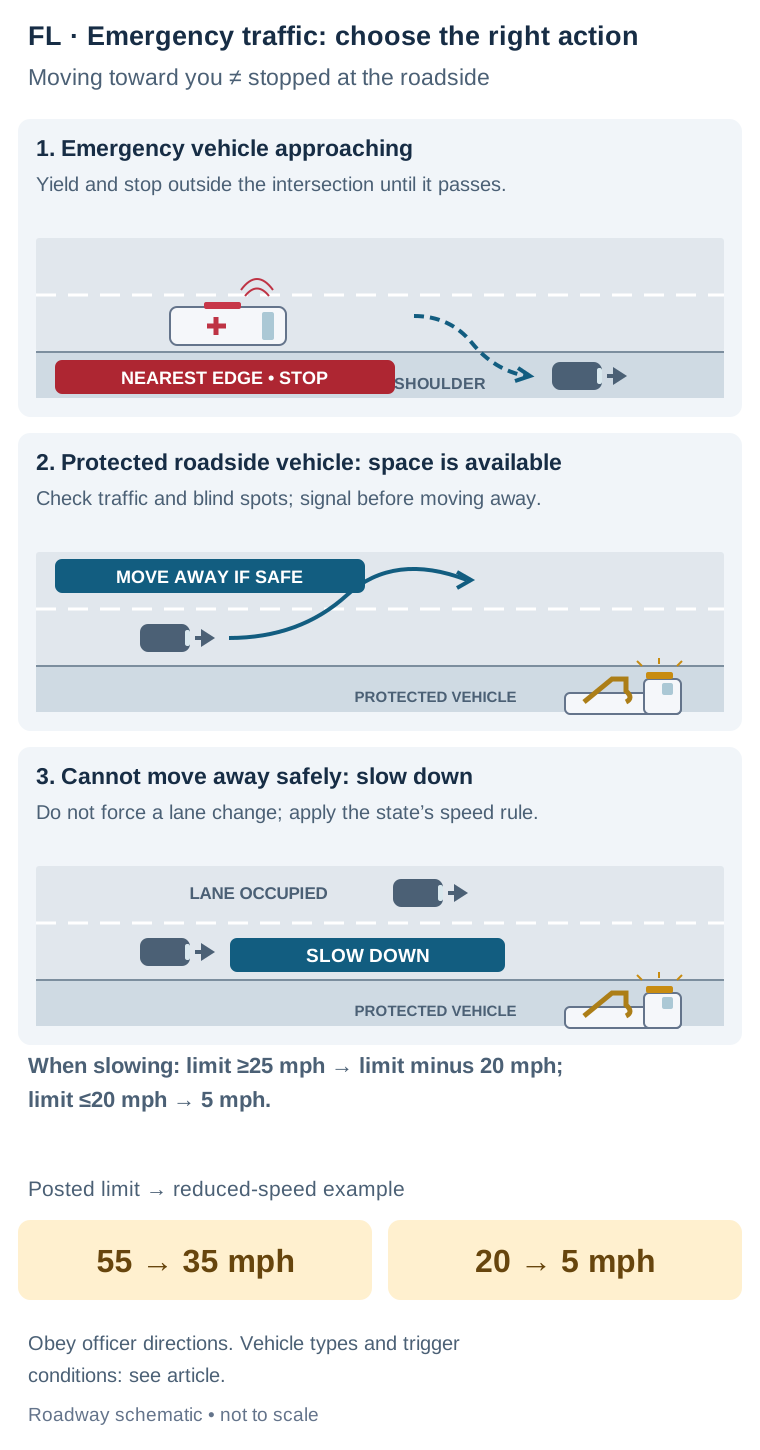
The diagram shows an ambulance using emergency signals and a stationary tow truck working with the required warning lights. The roadside panels show two lanes in your direction only. Disabled-car conditions, two-lane roads and exact speed requirements are explained below. Select the image to enlarge it. Original diagram based on current official rules.
When an emergency vehicle is approaching
When an authorized emergency vehicle approaches on an emergency response with its siren or displayed blue or red lights, yield the right-of-way. Move as close as reasonably possible to the nearest roadway edge, clear of an intersection, stop and remain stopped until it passes, unless a law enforcement officer directs otherwise.
If you are already in an intersection, clear it safely before stopping. Keep your movements predictable, look for other traffic and avoid blocking the emergency vehicle’s path. Do not confuse this duty with merely changing one lane while continuing at road speed.
When the vehicle is stopped beside the road
The roadside rule protects several categories with specific conditions: emergency vehicles displaying visual signals; sanitation or utility vehicles performing roadside work; wreckers displaying amber lights during recovery or loading; and specified road or bridge work vehicles displaying warning lights without advance signs and channelizing devices.
It also covers a stopped disabled motor vehicle when it displays warning or hazard lights, uses emergency flares or emergency signage, or has one or more people visibly present. A private car can therefore trigger the duty; it does not need a government logo. A visible person is an alternative condition, so do not assume hazard lights must also be on.
On a highway with two or more lanes in your direction, safely leave the lane closest to the protected vehicle. Check mirrors and blind spots, signal and take an available gap. If you cannot safely move over, use the slowdown requirement. On a two-lane road, use the slowdown requirement directly. Follow an officer’s directions where given. FLHSMV summarizes the actions on its Move Over page.
Calculate the slowdown from the posted limit
When the slowdown requirement applies:
| Posted speed limit | Required passing speed under the rule |
|---|---|
| 55 mph | 35 mph: 20 below the posted limit |
| 35 mph | 15 mph: 20 below the posted limit |
| 25 mph | 5 mph: 20 below the posted limit |
| 20 mph or less | 5 mph |
“Slow to 20 below” uses the posted limit, not your current speed. If you were already traveling below the limit, subtracting 20 from that speed does not describe the statutory calculation. Traffic, visibility and other conditions can require additional caution.
Practice the decision before you need it
Imagine a car stopped on the shoulder of a 55-mph road with hazard lights on. In the nearest of two lanes traveling your direction, first look for a safe move into the farther lane. If that movement is unsafe, slow under the rule to 35 mph. On a two-lane road posted at 20 mph, the applicable passing speed is 5 mph.
Now replace the parked car with an approaching fire engine using emergency signals: prepare to yield, clear the intersection and stop at the roadway edge. When reviewing with FL Driver, identify whether the vehicle is approaching or stopped before deciding on an action. The scenarios here explain the rule and are not official exam questions.
FL Driver
Use FL Driver for practice in English, Spanish or Chinese, then review your mistakes. App questions are independent study material.