NCSigns & road rules3 min readUpdated
North Carolina school buses: when both directions must stop
Learn North Carolina school-bus stop signals and the specific opposite-direction exceptions for medians and center turn lanes.
By the US DMV editorial team · Passenger-car permit study
When a North Carolina school bus stops for passengers, check the bus signals, your direction and the road layout. A center turning lane does not create the same result on every road.
Compare the road layouts
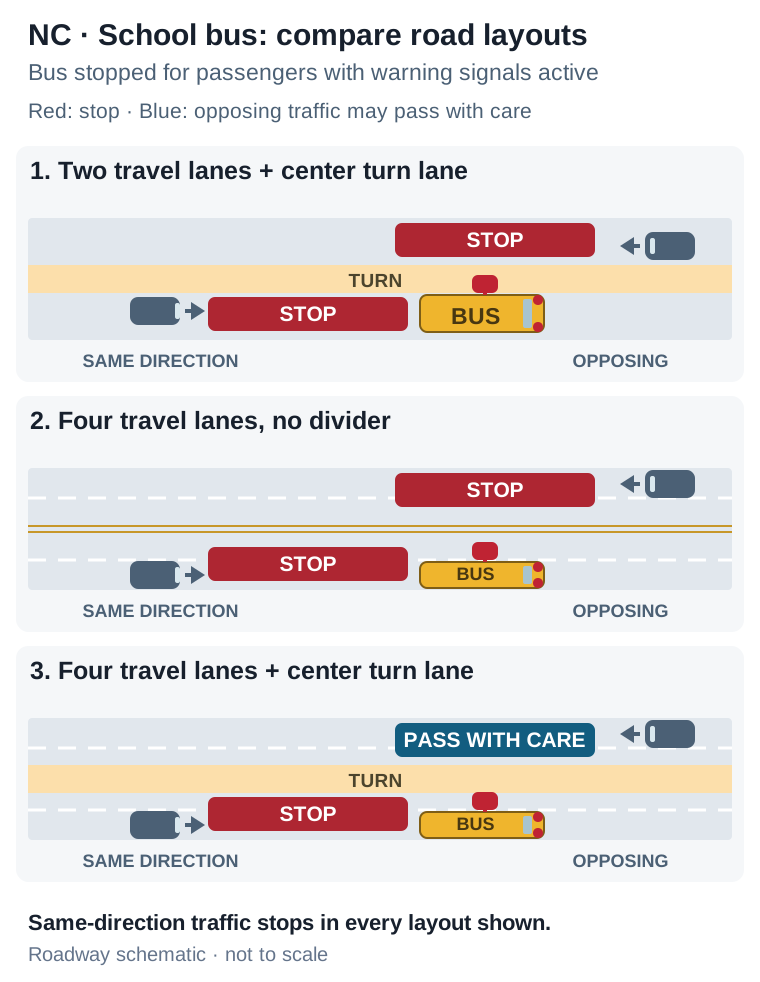
Open the diagram to enlarge it. Original roadway schematic based on the linked official rule. Read the full conditions below. G.S. 20-217.
Stop for the passenger-loading signals
Under G.S. 20-217, when a school bus is stopped to receive or discharge passengers and displays its mechanical stop signal or flashing red lights, approaching drivers must come to a full stop, subject to the opposite-direction exception below. The general rule covers approaches from any direction on the same street, highway or public vehicular area.
Remain stopped until the mechanical stop signal is withdrawn, the flashing red lights are off and the bus has started moving. Do not use another driver’s movement as permission to pass. Watch for children whose view of traffic may be blocked by the bus.
When you see the bus slowing and warning of a stop, ease off early and prepare to stop. Do not accelerate to squeeze past before passengers cross.
Distinguish these five layouts
The NC Department of Public Safety school-bus guide gives these practical cases:
| Road layout | Who must stop for the bus signals? |
|---|---|
| Two-lane road: one through lane each way | Both directions |
| Two through lanes total plus a center turning lane | Both directions |
| Four-lane road without median separation | Both directions |
| Divided highway with four or more through lanes and a median | Traffic traveling in the bus’s direction; opposite roadway traffic is excepted |
| Four or more through lanes plus a center turning lane | Traffic traveling in the bus’s direction; opposite-direction traffic is excepted |
For the center-turn-lane exception, the statute requires at least four other lanes, in addition to the center left-turn lane. A road with one through lane each way plus a shared center turn lane has only two other lanes: both directions stop. Four through lanes alone, separated only by a painted centerline, also require both directions to stop.
The statutory exception applies when the bus is across an intervening dividing space or physical barrier on the opposite roadway. It does not excuse vehicles traveling with the bus, including drivers who could otherwise move into a lane beside it. A spare lane is not permission to pass.
Apply the rule before reaching the bus
On a road with two lanes each way and a center turn lane, a driver behind the bus stops; a driver approaching from the opposite direction may use the stated exception. On a narrower road with one lane each way and a center turn lane, the opposite-direction driver also stops.
Identify the layout ahead of time on your regular routes. At intersections, do not assume a green light or planned turn cancels the school-bus rule; watch the bus, signals and children, and obey an officer directing traffic.
The North Carolina Driver Handbook includes diagrams of these layouts. Review them alongside the knowledge-test resources, then practice another lane-choice situation with the Move Over guide.
Put what you learned into practice
NC Driver is coming soon. Use the state study resources and official handbook in the meantime.
State study resources